

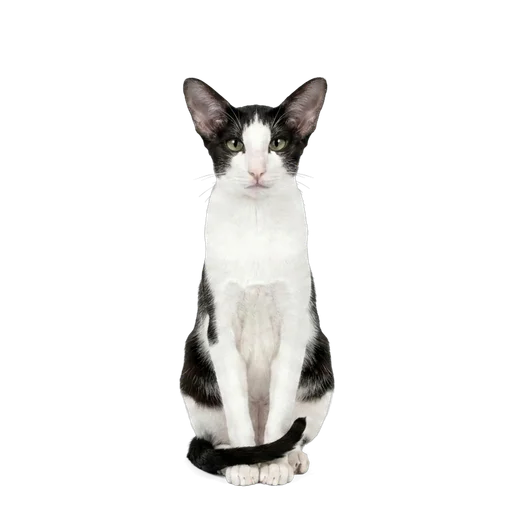
Origin: United States
Oriental Bicolor
Get reminders for your Oriental Bicolor's vaccines
Vaccination and parasite reminders, food-safety scans and health records — free to start in the Pethls app.


Good for
The Oriental Bicolor is an Oriental-type cat wearing white patching over any Oriental color, from black-and-white to chocolate tabby-and-white. Underneath the paint job sits the full Siamese-family package: a slim, athletic body, oversized ears, and a personality that fills the whole house. These cats talk, climb, fetch, and attach themselves to their people with an intensity that surprises first-time owners. A medium cat of 3.5 to 5.5 kg, the Oriental Bicolor typically lives 8 to 12 years, and well-bred cats from tested lines often reach their mid-teens. It rewards busy, engaged households and struggles badly in empty ones. It shares the Siamese family's known health concerns, so choosing a health-testing breeder and keeping up with regular vet care both matter.
Temperament & personality
Live with an Oriental Bicolor for a week and you will know its opinion on everything. This is one of the most vocal cat breeds, with the classic Oriental voice: loud, raspy, and used constantly, at you, about you, and sometimes just into the empty kitchen. The talking never stops, so you either love the running commentary or you pick a quieter breed.
The bond with people is the defining trait. An Oriental Bicolor picks its humans and stays physically close to them: on the lap, on the shoulder, under the blanket at night. They greet you at the door, supervise your cooking, and inspect every grocery bag. That devotion has a hard edge, though. These cats genuinely hate being alone, and long empty workdays produce anxiety, destructive scratching, overgrooming, or nonstop howling. A second cat, ideally another Oriental or Siamese type, makes single-person households workable.
Intelligence and athleticism run high. Expect a cat that opens cabinets, learns fetch without being taught, and reaches the top of the bookcase in two jumps. Clicker training, puzzle feeders, tall cat trees, and 20 to 30 minutes of real interactive play daily are not luxuries here; they are how you keep the cleverness pointed somewhere harmless. With children who respect a cat's signals, and with cat-friendly dogs, most Oriental Bicolors integrate happily because they simply want company.
Vaccination schedule
Core vaccination starts with FVRCP at 6 to 8 weeks of age, covering feline viral rhinotracheitis, calicivirus, and panleukopenia. Kittens receive boosters every 3 to 4 weeks until at least 16 weeks old. Getting that final dose at 16 weeks or later matters, because maternal antibodies can neutralize earlier shots and leave a gap in protection right when a young Oriental is at its most social and mouthy.
Rabies is given between 12 and 16 weeks, then boosted at one year and every one to three years after that depending on the licensed product and state law. FVRCP is boosted at one year, then typically every three years for a healthy indoor adult. Siamese-family cats occasionally react to vaccines with a day of lethargy or a small lump at the injection site; mention any past reaction to your vet so they can adjust timing or premedicate.
FeLV vaccination is recommended for all kittens, then continued annually only for cats with outdoor access, catio time with unknown visitors, or housemates of unknown FeLV status. Most Oriental Bicolors live strictly indoors, both because breeders require it and because a lean, curious, people-seeking cat does poorly loose outside, so many can drop FeLV after the kitten year. Review the decision with your vet whenever the household changes.
Best food & diet
Orientals are built like whippets and burn energy accordingly. A 4 kg Oriental Bicolor in constant motion can need noticeably more calories per kilogram than a sedentary moggy, especially through the athletic first three or four years. Feed a high-protein, meat-first complete diet meeting AAFCO life-stage standards, and split it into three or more small meals or puzzle-feeder sessions, which also gives that busy brain a job.
Wet food should carry most of the diet. Like all cats, Orientals benefit from high dietary moisture to support urinary and kidney health, and moisture is the cheapest protection you can buy. Add a cat water fountain; most Orientals find running water irresistible and drink more from it.
Two breed-specific cautions. First, some Orientals are enthusiastic, fast eaters that vomit after gulping; slow-feeder bowls fix this cheaply. Second, dental disease is common in the Siamese family, so build daily tooth brushing into feeding time from kittenhood while the cat still thinks everything is a game. Neutered Orientals can also flip from lean to pot-bellied surprisingly fast after their activity drops in middle age, so weigh monthly and adjust portions early rather than dieting later.
Common health problems
Feline asthma appears in the Siamese family more than in most breeds, and the Oriental Bicolor inherits that risk. Watch for episodes of wheezing, open-mouth breathing, or a crouched, neck-extended cough that owners often mistake for hairballs that never come up. Asthma is manageable with inhaled or oral medication, but an acute attack is an emergency. Video any suspicious episode on your phone; it is the single most useful thing you can show your vet.
Dilated cardiomyopathy (DCM), a weakening and enlargement of the heart muscle, is worth knowing about in any cat. It became rare after taurine was added to commercial diets, so it is now largely a diet-related rather than an inherited disease, and it is not a recognized heritable problem of Oriental-type cats. A vet listening for murmurs and gallop rhythms at every annual exam, with an echocardiogram if anything sounds off, is the practical screening route, and feeding a complete AAFCO diet removes the main modern risk. Sudden hind-leg weakness or laboured breathing needs same-day care.
Progressive retinal atrophy (PRA) causes gradual blindness, usually starting with poor night vision. The good news is that the rdAc mutation responsible in the Siamese family has a cheap DNA test, so ask your breeder for the parents' PRA results; for this recessive rdAc mutation, two tested-clear parents cannot produce a kitten that goes blind from it. Amyloidosis, an abnormal protein deposit that can affect the liver and/or kidneys in the Siamese and Oriental group, is the hardest condition to screen for. There is no test, so know the signs: unexplained weight loss, lethargy, or jaundice in a young to middle-aged cat warrants bloodwork promptly. Dental disease is common in this family too and shows up early on an annual exam.
Allergies & skin
The Oriental Bicolor's fine, short, close-lying coat sheds lightly, and allergic visitors sometimes report milder reactions than around fluffier cats. Do not read that as hypoallergenic. Orientals produce normal Fel d 1 allergen in their saliva and skin, and their habit of sleeping on your pillow delivers it efficiently. Allergic buyers should spend a proper afternoon with adult cats from the breeder before committing.
The cat's own skin is generally trouble-free, with one behavioral exception that matters a lot in this breed: psychogenic alopecia, or stress overgrooming. An under-stimulated or lonely Oriental can lick its belly, flanks, or forelegs bald. Before it gets labeled behavioral, fleas, food allergy, and skin infection must be ruled out, but if the workup is clean, the prescription is company, play, and routine rather than medication.
Standard feline allergies occur too. Flea allergy dermatitis causes scabby bumps along the back and tail base and demands rigorous year-round flea control. Suspected food allergy, which usually shows as itching around the head and neck or chronic soft stool, is diagnosed with a strict 8 to 12 week elimination diet under vet guidance, not with a shop-bought grain-free swap. White patches on ears and nose can sunburn in strong light, so limit intense sun exposure for high-white cats.
Flea, tick & worm prevention
Keep an Oriental Bicolor on year-round flea prevention even if it never sets a paw outside. Fleas arrive on clothing, dogs, and visiting pets, and on a short pale-patched coat an infestation both spreads fast and shows fast. Use a cat-licensed monthly spot-on or a prescription oral product dosed to the cat's current weight, which for this breed means re-checking the weight of a still-growing athletic youngster every few months.
Never apply dog flea or tick products to a cat. Permethrin, common in dog spot-ons and sprays, is severely toxic to cats and regularly kills them; even rubbing against a freshly treated dog can cause tremors and seizures. In a mixed household, either move the dog to a cat-safe active ingredient or keep the animals separated until the dog's product has dried completely.
Tick prevention matters mainly for cats with catio, garden, or leash-walk access; several cat-safe spot-ons cover ticks alongside fleas. For worms, treat kittens for roundworms every 2 to 3 weeks from 3 weeks of age until 12 weeks, then monthly to 6 months. Indoor adults typically need worming every 3 months, and combined spot-ons can bundle flea and worm cover into one application. If your Oriental hunts on a catio or catches house mice, tighten to monthly and ask about tapeworm treatment specifically.
Medications & dosing
Every drug an Oriental Bicolor receives should be dosed to an accurate, recent weight. At 3.5 to 5.5 kg the range within the breed is wide enough that a dose right for the biggest male is excessive for a petite female. These lean cats also carry little body fat, which changes how some drugs distribute, so tell any new vet the cat's breed and let them see the body condition rather than assuming an average cat.
Sensitivity to certain anesthetics and sedatives is worth checking with your vet, who may adjust protocols as a precaution. This is worth a sentence to your vet before any dental cleaning or surgery. Cats with diagnosed asthma need extra care too: some drugs and stress itself can trigger episodes, so ask about pre-visit gabapentin if vet trips leave your cat wheezing.
Never medicate from the human cabinet. Paracetamol is fatal to cats in tiny amounts, ibuprofen destroys feline kidneys, and aspirin persists for days in their system. For asthma, the long-term standard is an inhaled corticosteroid given through a cat spacer mask; most Orientals accept the mask within a couple of weeks of treat-based training, and their trainability is a real advantage here. Give the full course of anything prescribed, log doses in a shared note so no one doubles up, and call the clinic rather than guessing whenever a dose is missed.
Grooming & coat care
This is close to the lowest-maintenance coat in the cat fancy. The Oriental Bicolor's fur is short, fine, and lies flat against the skin with minimal undercoat, so mats are essentially impossible and shedding is light. A weekly once-over with a soft rubber brush or grooming mitt lifts dead hair, and many owners finish by smoothing the coat with a chamois or even a silk cloth for shine. Baths are unnecessary unless the cat gets into something.
Use that weekly session as a health check, because on a lean, short-coated cat problems are visible early. Run your hands over the whole body feeling for scabs, lumps, or weight change, look at the white patches for any sunburn or staining, and check inside the enormous ears, which show wax and mites plainly and need only a wipe of the visible outer ear when dirty. Never push anything into the ear canal.
Teeth deserve more attention than the coat. With the family's tendency to gingivitis and periodontal disease, daily brushing with cat toothpaste is the single most valuable grooming habit for this breed, and a food-motivated, trainable Oriental usually accepts it faster than most cats. Add nail trims every 2 to 3 weeks. Expect the whole physical grooming routine, teeth included, to take under ten minutes a day, and remember that for this breed the real daily maintenance is play and company, not brushing.
How the Oriental Bicolor compares
Deciding between similar breeds? Here is the Oriental Bicolor next to Oriental Longhair.
| Oriental Bicolor | Oriental Longhair | |
|---|---|---|
| Size | Medium | Medium |
| Weight | 3.5-5.5 kg | 2.5-5.5 kg |
| Lifespan | 8-12 yrs | 12-15 yrs |
| Activity | Active | Active |
| Shedding | Low | Low |
| Good with kids | Yes | Yes |
| Apartment-friendly | Yes | Yes |
Frequently asked questions
How vocal is an Oriental Bicolor really?
Very. This family talks more than almost any other breed: loud, raspy, and frequent, including conversations at night if the cat is bored or lonely. Owners describe it as living with a chatty roommate. If constant meowing would wear on you or thin apartment walls, pick a quieter breed, because you cannot train the voice out of an Oriental.
Can an Oriental Bicolor be left alone during work hours?
A full workday alone, every day, is genuinely hard on this breed and tends to produce howling, overgrooming, or destructive behavior. The most reliable fix is a second sociable cat, ideally another Oriental or Siamese type. Failing that, a household where someone is home most of the day, plus serious play before and after work, is the minimum.
What health tests should the breeder show me?
Ask for the parents' PRA (rdAc) DNA test results at minimum; two clear parents cannot produce a blind-from-PRA kitten. A recent heart check or echocardiogram history in the lines is a strong plus given dilated cardiomyopathy in Oriental types. A good breeder will also discuss asthma, amyloidosis, and dental disease in their lines openly rather than claiming the breed has no issues.
My Oriental makes a hunched coughing motion but no hairball comes up. Should I worry?
Yes, take it seriously. That crouched, neck-extended cough with nothing produced is the classic presentation of feline asthma, which is overrepresented in the Siamese family. Video an episode on your phone and book a vet visit; repeated attacks, wheezing, or any open-mouth breathing is an emergency. Asthma is very manageable once diagnosed, usually with an inhaler and spacer mask.
Why is the lifespan listed as 8 to 12 years when some Siamese live to 18?
The 8 to 12 year figure is the published range for the breed, and it is realistic for the population as a whole. Plenty of well-bred Oriental Bicolors from tested lines live into their mid-teens, so treat 8 to 12 as a baseline rather than a cap. Your best levers are choosing a health-testing breeder, keeping the cat lean and indoors, brushing teeth daily, and staying on top of annual exams.
Related breeds
Health and care information is drawn from established veterinary sources and is general guidance, not veterinary advice. See our sources
Keep records for your Oriental Bicolor
Vaccinations, food and treat safety, allergy alerts and parasite reminders - all tracked for your Oriental Bicolor in the Pethls app.