

Origin: Russia
Russian White, Black and Tabby
Get reminders for your Russian White, Black and Tabby's vaccines
Vaccination and parasite reminders, food-safety scans and health records — free to start in the Pethls app.


Good for
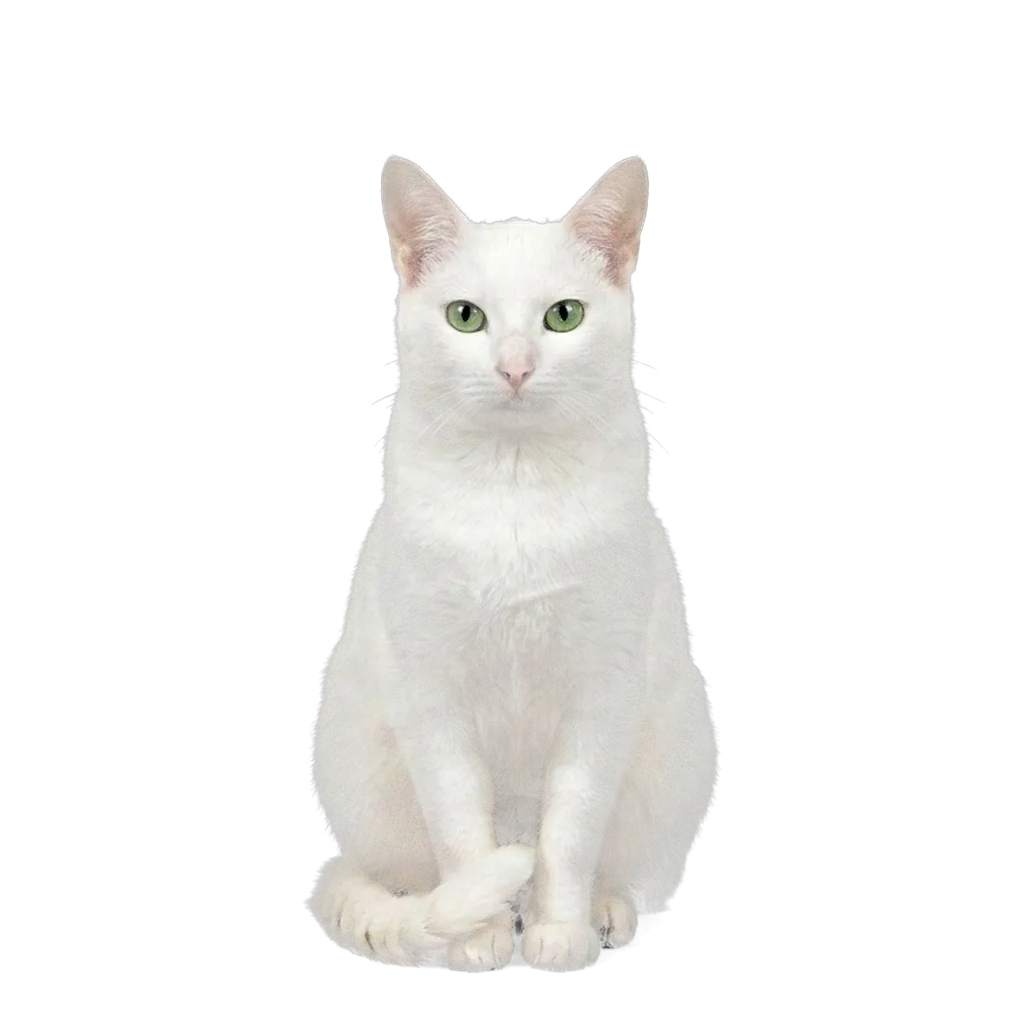
The Russian White, Black and Tabby are sister breeds to the Russian Blue. The Russian Blue itself has a lineage that traces to Russia, but these color variants are an Australian development: breeder Mavis Jones created them from the 1970s onward by crossing Russian Blues with white and black domestic cats, then breeding back to Russian type. The White and Black are the well-established results; the Tabby is far less consistently recognized, and many registries do not breed Russians as tabbies at all. They keep everything owners love about the Blue: the plush double coat, now in white, black, or tabby instead of the classic silvery blue, the quiet voice, and the gentle, slightly reserved nature. All of it comes in a medium 3.5 to 5.5 kg frame with a healthy 10 to 15 year lifespan. These are devoted, soft-spoken cats that pick their people carefully and hold back around strangers. Like the Russian Blue, they are often better tolerated by allergy sufferers, though they are not truly hypoallergenic. Registries in Australia and elsewhere recognize the White and Black; in some associations they are simply grouped as Russian cats in additional colors.
Temperament & personality
These are the Russian temperament in a different coat: quiet, sweet-natured, and observant, with a soft chirping voice they use sparingly. At home with their own people they are affectionate in an understated way: following you between rooms, settling beside you rather than on you, and reserving the lap for the humans they trust most. They tend to choose one or two favorites in the household and show them a devotion that Russian owners describe as almost dog-like.
With strangers they tend to disappear. Most Russian Whites, Blacks and Tabbies retreat when the doorbell rings and study visitors from a hallway or the top of a cat tree before deciding, often over multiple visits, whether to come closer. This is caution, not fearfulness, and it never fully goes away. Give the cat escape routes and never force introductions; a Russian courted on its own timetable becomes remarkably confident, while one cornered by an enthusiastic guest simply learns to hide sooner.
Day to day they are moderately active and very easy to live with. They play with genuine athleticism in short bursts, love a feather wand and a sunny windowsill, and then settle for long stretches. Routine matters to them: fed, played with, and greeted at the same times, they thrive, and they handle quiet, predictable households, including gentle children and calm resident pets, better than chaotic ones. They also tolerate reasonable alone time better than most sociable breeds, which makes them a realistic choice for working owners.
Vaccination schedule
Russians follow the standard feline core schedule. FVRCP, protecting against feline viral rhinotracheitis, calicivirus, and panleukopenia, starts at 6 to 8 weeks of age, with boosters every 3 to 4 weeks until the kitten is at least 16 weeks old. The final dose at or after 16 weeks is the one that reliably takes, once maternal antibodies have faded, so do not stop the series early even if the kitten already seems healthy and robust.
Rabies is given once at 12 to 16 weeks where required or recommended, boosted at one year, then every one to three years depending on the product and local regulations. Requirements differ between countries; rabies is mandatory in most US states, while vaccination advice in Australia, where these breeds were developed, follows different local guidance. Follow your own vet's protocol for your cat's situation.
FeLV is recommended for all kittens by major guidelines and then continued annually only for cats with outdoor access or exposure to untested cats. Most Russians live strictly indoors, so once the kitten series is done, whether they need FeLV boosters after the first year comes down to their exposure risk, not their personality. One practical breed note: these reserved cats find vet visits stressful, so combining vaccinations with as few separate trips as possible, using a familiar carrier left out at home year-round, and asking about pre-visit calming protocols makes the whole schedule easier on everyone.
Best food & diet
Feed a complete, meat-first diet appropriate to life stage, and be disciplined about portions. Russians are famously food-motivated, and the plush double coat hides weight gain well; more than a few owners discover at the annual weigh-in that their sleek cat has quietly become a heavy one. Measure meals rather than free-feeding, keep treats under ten percent of daily calories, and body-condition check monthly by feeling for ribs through that dense coat, since you cannot judge this breed by eye.
Water intake deserves special attention in these breeds because urinary tract disease is one of their few documented weak points. Build the diet around wet food, which is roughly 70 to 80 percent water against about 10 percent for dry kibble, and add a water fountain or multiple wide bowls away from the food station. A cat that eats mostly wet food and drinks freely produces more dilute urine, which is one of the simplest ways to protect against urinary trouble.
Beyond that, their needs are unremarkable. A high-quality commercial diet meeting AAFCO or FEDIAF standards covers a Russian's needs from kittenhood to old age. Neutered adults, which is most of them, often do well on a slightly reduced-calorie adult formula from about 12 months. If your vet ever recommends a urinary or weight-management prescription diet after an episode of cystitis or creeping weight, take the advice seriously; in this breed those two issues are connected, since overweight cats have higher urinary risk.
Common health problems
This is a hardy family of cats. Like the Russian Blue they descend from, the White, Black and Tabby carry no long list of breed diseases, and well-bred cats commonly reach their mid-teens with little more than routine care. Two conditions deserve genuine attention, and the first is hypertrophic cardiomyopathy (HCM), the thickening of the heart muscle that is the most common heart disease across all cats. It has been reported in Russian lines, so ask breeders whether they heart-screen their breeding cats, and make sure your vet listens carefully at every annual exam. A murmur, a gallop rhythm, or unexplained fast breathing at rest justifies an echocardiogram; some cats show no warning at all, which is exactly why the yearly exam is non-negotiable.
The second is lower urinary tract disease, an umbrella covering cystitis, crystals, stones, and in male cats the emergency of a blocked urethra. Signs are frequent small trips to the tray, straining, crying in the box, blood-tinged urine, or urinating outside the tray from a previously clean cat. A male cat straining and producing nothing needs a vet within hours, not days, because a full blockage kills. Prevention leans on the water strategies above, lean body weight, enough clean litter trays (one per cat plus one), and low household stress, which matters more in a sensitive breed like this than owners expect.
Beyond those two, care is standard: annual exams moving to twice yearly around age ten, dental checks since gingivitis spares no breed, and senior bloodwork to catch kidney and thyroid changes early. Obesity is the health problem you have the most control over here, and keeping the cat lean protects the heart, the urinary tract, and the joints all at once.
Allergies & skin
These breeds attract allergic buyers, so it is worth being clear about what the reputation means. Russian cats, including the White, Black and Tabby, are widely reported to trouble allergy sufferers less than average, possibly because some produce lower levels of the Fel d 1 allergen, and the dense double coat may hold dander close to the body rather than scattering it. As noted in the intro, though, this is milder tolerance, not true hypoallergenicity: individual cats vary enormously and a reaction is always possible. If you are allergic, arrange several long visits with the specific breeder's adult cats before paying a deposit and judge by your own symptoms.
The cat's own skin under that plush coat is usually excellent. The double coat protects well against minor scrapes and weather, and skin complaints are uncommon in the breed. The flip side is that the density hides problems, so scabs, flea dirt, and small lumps go unnoticed longer than on a thin-coated cat. Work your fingers through to the skin during weekly brushing, especially along the spine, tail base, and chin.
When skin trouble does appear, it follows the usual feline suspects in the usual order: fleas first, then food, then environmental allergy. Flea allergy dermatitis shows as pinhead scabs along the back and around the tail base, and it is largely preventable with consistent year-round flea control. Persistent itching, overgrooming a bald belly, or recurrent ear trouble deserves a vet workup rather than a diet experiment from the pet shop, and remember that in a reserved breed, overgrooming can also be a stress signal worth taking seriously.
Flea, tick & worm prevention
A dense double coat is prime flea real estate, and by the time you spot live fleas on a Russian, the home infestation is established. Keep every cat in the house on year-round prevention, indoor cats included, using a cat-licensed monthly spot-on or vet-prescribed oral product dosed to current weight. A flea comb run through the coat weekly, checking the debris on a wet white tissue for reddish flea dirt, is your early-warning system through fur this thick.
The non-negotiable safety rule: never use dog flea or tick products on cats. Permethrin, standard in many dog spot-ons, collars, and sprays, is severely toxic to cats, causing tremors, seizures, and frequently death. Cats have been poisoned just by sleeping against a recently treated dog, so in mixed households choose a cat-compatible product for the dog or keep the animals apart until the application is completely dry, and store the two species' products on different shelves.
Worming runs on the standard feline calendar. Kittens get roundworm treatment every 2 to 3 weeks from 3 weeks of age until 12 weeks, then monthly until 6 months old. Indoor adults are typically wormed every 3 months, while cats with garden or catio access, or any hunting habit, may need monthly treatment plus specific tapeworm cover. Combination spot-ons that pair flea and worm control in one monthly application suit this breed well; part the coat thoroughly to reach skin at the base of the skull, because product left sitting on top of a double coat is product wasted.
Medications & dosing
All feline medication is weight-based and vet-directed, and for this breed an accurate scale matters twice over: the 3.5 to 5.5 kg range is wide, and the plush coat disguises both weight gain and weight loss. Weigh your cat at home monthly on baby scales or at every clinic visit, and have doses recalculated whenever the weight moves rather than refilling old prescriptions on autopilot.
Keep human medicines away from cats entirely. Paracetamol is lethal to cats in a fraction of a child's dose, ibuprofen and other human anti-inflammatories cause kidney failure and gastric ulcers, and aspirin lingers dangerously in feline metabolism. A cat that seems sore, quiet, or off its food gets a phone call to the clinic, not half a tablet from the bathroom cabinet. Cat-licensed painkillers exist and work well, but only at feline doses under veterinary direction.
Two more points specific to this breed. If HCM is ever diagnosed, lifelong cardiac medication must be given consistently and on schedule, and the good news is that a routine-loving Russian takes to a fixed pill-in-treat ritual faster than most cats; start practicing with empty treat wraps early in life. Second, for urinary episodes, vets often prescribe analgesia and sometimes antispasmodics alongside diet change, and finishing the full course matters even after symptoms vanish. For this easily stressed breed, ask your vet about gabapentin before travel or clinic visits; a calm cat is safer to treat and easier to examine.
Grooming & coat care
The signature plush double coat, short, dense, and standing slightly off the body, is easier to maintain than it looks. It resists matting almost completely, and a once-weekly session with a slicker brush or fine comb, worked gently down to the skin, keeps it in order for most of the year. Many owners finish with a rubber grooming mitt to lift the last loose hairs and polish the coat. Baths are almost never needed; the coat repels dirt naturally.
Shedding sits in the low-to-medium band. Day to day the coat drops little, noticeably less around the house than an average shorthair, but the dense undercoat does a proper molt once or twice a year, typically spring and autumn. During those few weeks, step up to brushing every day or two. It controls the drifts of undercoat, reduces the hair the cat swallows, and cuts down on hairballs, and food-motivated Russians usually learn to enjoy the routine quickly if it ends in a treat.
Complete the routine with nail trims every 2 to 3 weeks, a weekly glance in the ears with a wipe of the visible part only when waxy, and dental care, ideally daily brushing with cat toothpaste, realistically at least several times a week backed by annual dental checks. Handle paws, ears, and mouth from kittenhood; with this gentle but reserved breed, early habituation is the difference between a cat that tolerates grooming and one that vanishes at the sight of the brush. All in, expect fifteen minutes a week outside molting season.
How the Russian White, Black and Tabby compares
Deciding between similar breeds? Here is the Russian White, Black and Tabby next to American Bobtail and American Shorthair.
| Russian White, Black and Tabby | American Bobtail | American Shorthair | |
|---|---|---|---|
| Size | Medium | Medium | Medium |
| Weight | 3.5-5.5 kg | 3-7 kg | 3.5-7 kg |
| Lifespan | 10-15 yrs | 13-15 yrs | 15-20 yrs |
| Activity | Moderate | Moderate | Moderate |
| Shedding | Medium | Medium | Medium |
| Good with kids | Yes | Yes | Yes |
| Apartment-friendly | Yes | Yes | Yes |
Frequently asked questions
Are Russian White, Black and Tabby cats the same as Russian Blues?
They are sister breeds, not the same breed. They were developed in Australia in the 1970s by crossing Russian Blues with domestic cats carrying white, black, and tabby, then breeding back to Russian type. A well-bred Russian White or Black is essentially a Russian Blue in a different color: same plush double coat, same quiet, gentle, people-devoted nature. Recognition varies by registry; some group them all simply as Russian cats.
Are they hypoallergenic?
No, though the reputation has a kernel of truth. Russian cats may produce less Fel d 1 allergen than average, and many allergy sufferers report milder reactions around them. But no cat breed is allergen-free, individual cats vary widely, and reactions are still entirely possible. Before committing, spend several extended visits with the breeder's adult cats and judge by your own symptoms, not by marketing.
Will one of these cats warm up to visitors?
Slowly, sometimes, and on the cat's terms. Reserve with strangers is a genuine breed trait, not poor socialization. Most will watch new people from a distance and may approach quiet, patient regulars after a few visits, while boisterous guests get avoided indefinitely. With their own family the same cat is affectionate and devoted. Provide hiding spots and never force introductions; pressure only deepens the shyness.
What health screening should I ask a breeder about?
Ask whether breeding cats are screened for hypertrophic cardiomyopathy, ideally by echocardiogram, since HCM is the main heart concern in Russian lines. There is no breed-specific DNA panel to demand; these are generally hardy cats. Beyond heart screening, look for a breeder who raises kittens indoors, vaccinates and worms on schedule, and talks openly about urinary issues and longevity in their lines.
How do I protect a Russian cat from urinary problems?
Focus on water, weight, and calm. Feed mostly wet food, run a water fountain, and keep the cat lean, because obesity raises urinary risk sharply. Provide one litter tray per cat plus one, cleaned daily, and keep household routines stable, since stress triggers cystitis in sensitive cats. Know the red flags: straining, frequent small urinations, blood in urine, or a male producing nothing at all, which is an emergency needing a vet within hours.
Related breeds

Health and care information is drawn from established veterinary sources and is general guidance, not veterinary advice. See our sources
Keep records for your Russian White, Black and Tabby
Vaccinations, food and treat safety, allergy alerts and parasite reminders - all tracked for your Russian White, Black and Tabby in the Pethls app.