

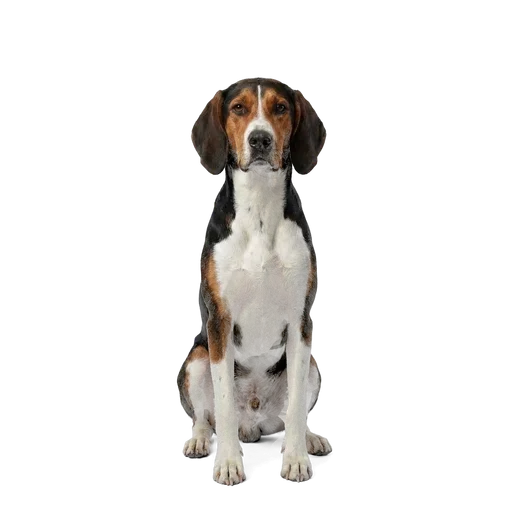
Origin: United Kingdom
English Foxhound
Get reminders for your English Foxhound's vaccines
Vaccination and parasite reminders, food-safety scans and health records — free to start in the Pethls app.


Good for
The English Foxhound is the original pack hound of the British hunt, bred for some three centuries to run 25 to 30 miles a day behind a scent in all weather. That history built a friendly, gentle, extraordinarily social dog and one of the hardiest breeds in existence, with most individuals living 10 to 13 years at 29 to 34 kg. It also built an athlete whose exercise needs dwarf almost every other breed's. English Foxhounds remain rare as house pets, and the honest reason is that few homes can supply the mileage, the secure fencing and the tolerance for baying that this hound requires.
Temperament & personality
Centuries of kennel life in packs of forty or more hounds produced a dog with essentially zero dog aggression and an easy, amiable way with people. English Foxhounds are gentle with children, welcoming to visitors and happiest with canine company; a single-dog household leaves them lonelier than most breeds.
Independence is the flip side. A pack hound was never bred to check in with a handler; it was bred to follow a fox line for hours without instruction. Recall training is a long project with modest returns, and once the nose locks onto a scent the ears switch off. Off-lead freedom is only safe in genuinely enclosed spaces, and the garden fence needs to be high and dig-proof.
Then there is the voice. Foxhounds bay, a deep, carrying, musical sound that hunt followers love and neighbors do not. It is not a habit you train out; it is the breed doing its job. Detached housing and understanding neighbors are close to prerequisites.
Meet the exercise need, roughly 2 hours of hard activity daily, and the reward is a remarkably even-tempered, low-drama companion that sleeps deeply and asks for little. This breed suits runners, riders, canicross enthusiasts and rural households, not busy families hoping a big garden will do the work.
Vaccination schedule
Foxhound puppies take the standard core course: DHPP (distemper, adenovirus hepatitis, parvovirus, parainfluenza) starting at 6 to 8 weeks and repeating every 3 to 4 weeks until at least 16 weeks of age. Parvovirus protection deserves particular care in any puppy that will later mix widely with other dogs.
Rabies is given from 12 to 16 weeks where required by law, boosted at one year, then on a 1 to 3 year cycle depending on jurisdiction and vaccine. Keep records tidy if the dog will travel.
A hound that covers real country and mixes with other dogs is a strong candidate for leptospirosis and kennel cough vaccination. Lepto lives in waterways and rodent-frequented ground, exactly the terrain a Foxhound crosses at speed. Ask your vet to tailor the non-core choices to your area.
Best food & diet
Puppies should eat a large-breed growth diet with controlled calcium, kept lean throughout the growth phase to protect developing hips. Resist the urge to bulk up a rangy adolescent; Foxhounds are built lean and racy, and the last two or three ribs showing faintly is correct condition, not underfeeding.
An adult in serious work is a genuine endurance athlete and may need a performance diet with 25 percent or more protein and elevated fat. The same hound doing an hour of pet exercise a day needs far less, and hounds are enthusiastic, food-driven eaters that gain weight easily when under-exercised. Measure meals and weigh the dog every month or two.
Feed two meals daily rather than one, and keep hard exercise separated from mealtimes by an hour. Because kidney disease is documented in the breed, ask your vet about routine blood and urine screening from middle age onward; if kidney values ever drift, diet becomes the main management tool and catching it early widens your options.
Common health problems
Centuries of ruthlessly functional breeding made the English Foxhound one of the healthiest dog breeds on record. Most live their 10 to 13 years with little more than routine care. Still, three conditions are documented in the breed and worth knowing.
Hip dysplasia appears at low rates but does occur in a dog this size. Choose a breeder who hip-scores, keep the hound lean and watch for stiffness after long runs in older dogs. Renal disease, including a familial amyloidosis reported in some lines, makes annual senior bloodwork and urine checks a worthwhile habit from about age seven.
The one to flag is thrombopathia, an inherited platelet function disorder in which platelets are present in normal numbers but do not clot properly. Affected hounds may bruise easily, bleed longer from small cuts or have nosebleeds. Tell your vet the breed carries this before any surgery, including routine neutering, so clotting can be assessed first; a simple buccal mucosal bleeding time test is often used as a screen.
Allergies & skin
The English Foxhound is not hypoallergenic. Its short, hard coat sheds a steady, moderate amount year-round, and the breed produces normal levels of the dander and saliva proteins that set off human allergies. Weekly brushing reduces loose hair around the house without changing that basic fact.
The hounds themselves have famously undemanding skin. Allergic disease is less common than in many popular breeds, but individual dogs can still develop atopy or food sensitivity, usually announced by paw chewing, recurrent ear irritation or belly rash. Persistent scratching deserves a vet workup rather than repeated medicated baths.
The practical skin care for this breed is field maintenance: check for cuts, thorn punctures and grass seeds after runs through cover, and remember that easy bruising or a wound that oozes longer than expected is worth mentioning to your vet given the thrombopathia background.
Flea, tick & worm prevention
Few pet dogs cover more tick country per week than a Foxhound doing proper mileage. Year-round flea and tick prevention is essential, using a monthly chewable or long-acting spot-on, backed by hands-on checks of ears, neck, armpits and groin after rural runs. UK and European ticks transmit Lyme disease and anaplasmosis, and babesiosis is spreading northward.
Worming starts at 2 weeks of age in puppies, repeating fortnightly until 12 weeks and then monthly to 6 months. Adults with this breed's outdoor lifestyle, and its readiness to snack on droppings and carrion, do best on monthly worming or quarterly faecal testing, with tapeworm treatment included for scavengers.
Add heartworm prevention in endemic regions and ask about lungworm risk if you are in an affected area of the UK. Whatever products you choose, buy them dosed for the hound's current weight, not last year's.
Medications & dosing
Like all dogs, Foxhounds are dosed by weight, in this breed usually 29 to 34 kg, which places many hounds near the top of a product's dose band. Weigh the dog rather than assuming, and remember that a fit hound in hard condition and the same hound softened over an idle winter can differ by several kilograms.
Thrombopathia changes the medication conversation for this breed specifically. Drugs that impair platelet function, most notably aspirin and other NSAIDs, deserve extra caution in a breed with a known platelet disorder. Never give human painkillers on your own initiative, and make sure any vet treating your hound knows the breed history before prescribing anti-inflammatories or scheduling surgery.
Otherwise the rules are the usual ones: complete every prescribed course, store preventives dosed for the correct weight band, and phone the practice rather than guessing whenever a dose or a drug interaction is unclear. A cheap kitchen scale for pills and an accurate dog weight cover most dosing errors before they happen.
Grooming & coat care
This is close to the lowest-maintenance coat in dogdom. The short, dense, weatherproof jacket needs a weekly once-over with a rubber mitt or hound glove to lift dead hair and polish the coat, and that is genuinely most of the job. Baths are rare events, needed only after rolls in fox scent or worse.
Ears get a weekly check. The drop ears are shorter than a Bloodhound's and less trouble than most hound ears, but they still cover the canal, so look and sniff for wax, redness or odor, particularly after swimming or wet cover.
Nails on a hound doing real mileage often wear themselves down; pet-exercised hounds need trimming every 3 to 4 weeks. Add tooth brushing several times a week and a post-run check of pads and webbing for cuts and seeds, and the entire grooming routine fits comfortably inside fifteen minutes a week.
How the English Foxhound compares
Deciding between similar breeds? Here is the English Foxhound next to English Setter and Curly-Coated Retriever.
| English Foxhound | English Setter | Curly-Coated Retriever | |
|---|---|---|---|
| Size | Large | Large | Large |
| Weight | 29-34 kg | 20-36 kg | 27-41 kg |
| Lifespan | 10-13 yrs | 12-14 yrs | 10-12 yrs |
| Activity | Active | Active | Active |
| Shedding | Medium | Medium | Medium |
| Good with kids | Yes | Yes | Yes |
| Apartment-friendly | No | No | No |
Frequently asked questions
Is the English Foxhound a good house pet?
Only for a specific home. The breed is friendly, gentle and superb with other dogs, but it was bred to run up to 30 miles a day, it bays loudly, and its recall is unreliable around scent. Rural, active households with secure fencing and time for around 2 hours of daily exercise do best.
How much exercise does an English Foxhound need?
More than almost any other breed: roughly 2 hours of vigorous activity daily as a minimum for an adult. Running, canicross, cycling with the dog or accompanying horses suit them well. An under-exercised Foxhound becomes vocal, destructive and escape-minded.
Are English Foxhounds good with other dogs and children?
Excellent with other dogs, and good with children too. Pack breeding produced near-universal tolerance of other dogs and a gentle, patient manner with kids, with one caveat around small children. Supervise around toddlers simply because a 30 kg hound in motion can bowl a small child over by accident.
What is thrombopathia in English Foxhounds?
An inherited platelet function disorder documented in the breed. Platelet numbers are normal but clotting is impaired, so affected hounds may bruise easily or bleed longer from cuts. Vets can screen clotting before surgery, and owners should mention the breed risk before any operation or NSAID prescription.
Do English Foxhounds bark a lot?
They bay rather than bark, a deep, carrying hound voice used freely when excited, bored or on a scent. It carries across fields, which is the point. Training reduces nuisance noise somewhat, but a quiet Foxhound is not a realistic expectation, and close neighbors will hear it.
Related breeds



Health and care information is drawn from established veterinary sources and is general guidance, not veterinary advice. See our sources
Keep records for your English Foxhound
Vaccinations, food and treat safety, allergy alerts and parasite reminders - all tracked for your English Foxhound in the Pethls app.