

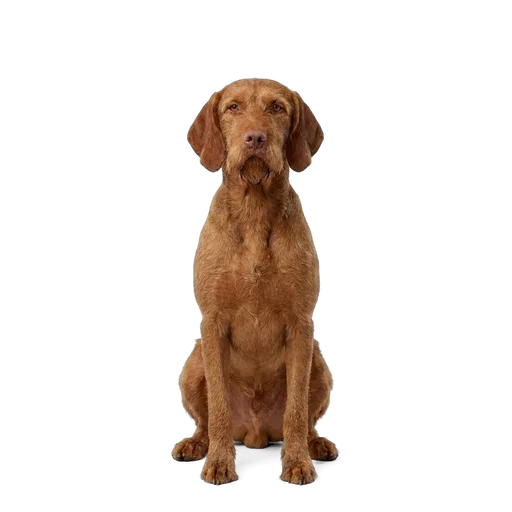
Origin: Hungary
Wirehaired Vizsla
Get reminders for your Wirehaired Vizsla's vaccines
Vaccination and parasite reminders, food-safety scans and health records — free to start in the Pethls app.


Good for
The Wirehaired Vizsla is the rugged cousin of Hungary's famous smooth-coated pointer, created in the 1930s by crossing Vizslas with German Wirehaired Pointers to build a dog that could work icy water and push through thorny cover without feeling the cold. What came out was the same russet-gold dog with the same famous velcro affection, wrapped in a weatherproof wire jacket with a beard and shaggy eyebrows. Expect 20 to 29 kg, a lifespan of 12 to 14 years, and a dog that needs both heavy exercise and near-constant company. This breed does not do alone. For an active household that wants a shadow with a hunting engine, there are few better dogs.
Temperament & personality
Everything people say about Vizsla attachment applies here in full. The Wirehaired Vizsla wants physical contact with its person for most of its waking hours: under your desk, against your leg, in your lap despite weighing 25 kg. Owners call them velcro dogs without irony. This makes for an intensely rewarding companion and a dog that suffers genuinely when left alone. Separation-related distress is one of the breed's most common behavioral challenges, and anyone working long days away from home should look at a different breed rather than trying to manage around it.
The energy is real but biddable. A Wirehaired Vizsla needs an hour or two of proper exercise daily, running, swimming, field work or fast-paced play, and it will happily do far more. The difference from harder-driving continental pointers is sensitivity: this dog trains on praise and partnership, wilts under harsh corrections, and works best as a partner rather than a dog taking orders. That softness means first-time owners can succeed, but only ones who are honest about the exercise and company requirements.
With children the breed is affectionate and tolerant, usually excellent once past the bouncy adolescent stage. Most Wirehaired Vizslas get along well with other dogs, and many live peacefully with cats they were raised alongside, though birds and small pets test the pointing instinct. Expect some vocal commentary, whining and talking rather than nuisance barking, and a dog that greets strangers warmly after a moment's assessment rather than with GWP-style reserve.
Vaccination schedule
Core vaccination follows the standard puppy timeline. DHPP (distemper, hepatitis/adenovirus, parvovirus, parainfluenza) starts at 6 to 8 weeks and repeats every 3 to 4 weeks until at least 16 weeks of age, typically three or four doses in total. The 16-week finish line matters: stopping early leaves a window where maternal antibodies have faded but vaccine protection never took hold, and parvovirus exploits exactly that gap.
Rabies is a single dose between 12 and 16 weeks depending on your local requirements, boosted at one year, then given every 1 to 3 years as the law and vaccine label dictate. After the first annual DHPP booster, most vets move to a 3-year core cycle. Keep records organized; hunt tests, group training and travel all ask for them.
A dog bred for water retrieving and rough-country bird work has field-dog exposure, so non-core vaccines are worth weighing up. Leptospirosis vaccination is worth strong consideration for any dog swimming in or drinking from natural water. Lyme vaccine earns its place in high-tick regions, and Bordetella covers dogs that board or train in groups. None of these replace parasite prevention; they stack with it.
Best food & diet
Feed to the engine, not the label. A Wirehaired Vizsla in regular work burns serious calories and does best on a quality complete food with named animal protein, split into two meals daily. Most adults land somewhere around 2.5 to 3.5 cups of dry food a day, but activity swings that number widely, so judge by body condition: a visible waist from above, a tuck-up from the side, ribs easy to feel through the wire coat. This is naturally a lean, leggy breed, and a fat Vizsla is a welfare problem in the making.
Puppies should grow slowly on a large-breed puppy formula with controlled calcium and calories, because hip and elbow dysplasia both occur in the breed and rapid growth stacks the deck badly. Keep the puppy lean through the growth phase and skip mineral supplements entirely unless a vet prescribes them.
Two breed-specific notes are worth flagging. First, hypothyroidism runs in these dogs, and unexplained weight gain on unchanged rations is one of its earliest signs, so track food amounts and weight rather than free-feeding. Second, on heavy work days feed well before or well after exercise, never immediately around it, and consider a performance formula in hunting season. Omega-3 fish oil is a sensible year-round addition for joints, coat and skin.
Common health problems
The Wirehaired Vizsla benefits from a broad founding gene pool and is generally healthy, with 12 to 14 years a fair expectation. The orthopedic concerns are the familiar sporting-breed pair: hip dysplasia and elbow dysplasia, both inherited and both screenable. Ask breeders for hip and elbow scores on both parents; in a breed this athletic, joint soundness matters a great deal. Watch young dogs for front-leg lameness after exercise (a classic elbow sign) and adults for stiffness after rest, bunny hopping or reluctance to jump.
Hypothyroidism deserves specific attention because its onset is sneaky. A middle-aged dog that gains weight, slows down, feels the cold, develops a dull thinning coat or gets repeated skin infections may well have low thyroid rather than simply be aging. Diagnosis is a straightforward blood panel and treatment is an inexpensive daily tablet, with dramatic improvement in most dogs. Given the breed disposition, any personality dimming in midlife warrants a thyroid check before it gets written off.
Progressive retinal atrophy (PRA) occurs in the breed. It is an inherited, painless, gradual degeneration of the retina that ends in blindness, with night vision failing first: hesitation on evening walks, bumping into things in dim rooms, reluctance on stairs after dark. There is no treatment, but DNA testing lets breeders avoid producing affected puppies, so ask about PRA status in both parents. Dogs that do go blind adapt remarkably well in a stable home, though losing sight in an active working dog is tough, which is why the testing matters.
Allergies & skin
The wire coat sheds lightly, noticeably less than the smooth Vizsla's, with a modest undercoat drop as seasons change. That is a genuine practical advantage for tidy houses, but it does not make the breed hypoallergenic. Dander and saliva carry the allergens, and this is an affectionate, face-licking, lap-seeking dog that shares them generously. Allergy-prone households should spend real time with adult Wirehaired Vizslas before committing.
The skin is generally sound, though the breed's russet coat and love of water create the usual field-dog issues. Dry the dog properly after swims so the undercoat does not hold damp against the skin, and inspect for grass awns and seeds after every outing in summer cover, especially in the ears, armpits and between the toes. White or pale markings on the chest and feet can be a touch more sun-sensitive in dogs that sunbathe.
Itchy skin that keeps coming back deserves a structured workup rather than rotating shampoos. Environmental allergy shows up as seasonal paw chewing, face rubbing and ear trouble. But in this breed, always rule out hypothyroidism when skin problems arrive alongside weight gain or coat thinning, since low thyroid degrades the skin barrier and invites recurrent infections. Fleas remain the single most common itch cause in all dogs, which is one more argument for unbroken year-round prevention.
Flea, tick & worm prevention
A dog built to hunt marsh, reed bed and upland cover in all weather collects ticks by the dozen in season. Year-round tick and flea prevention is the baseline for a Wirehaired Vizsla, not an optional extra: modern isoxazoline chews kill ticks before most pathogens transfer, and your vet can match the product to the local threat list, Lyme disease, anaplasmosis, ehrlichiosis and babesiosis in parts of Europe. Field dogs in peak season may justify layered protection with a repellent product, though combining preventives should be checked first for safety.
Back up the chemistry with your hands. After every hunt, swim or off-trail run, work through the coat with fingertips, paying attention to the ears, eyelids, lips, groin, armpits and toes; the wire coat and furnishings hide small ticks well. Pull attached ticks with fine tweezers at skin level and note the date. Lameness, fever or unusual lethargy in the weeks after exposure justifies a tick-borne disease test, because these infections respond best to early treatment.
Worming needs match the lifestyle. Puppies get dewormed every 2 to 3 weeks until 12 weeks old, then monthly until 6 months. Adult field dogs should run either monthly broad-spectrum prevention or fecal exams every 3 months with targeted treatment, and dogs that catch or mouth game need tapeworm coverage on top. In heartworm regions, monthly heartworm prevention is non-negotiable. Where lungworm occurs, dogs that eat slugs, snails or grass deserve specific coverage too, since risk varies sharply by region.
Medications & dosing
Canine drugs are dosed per kilogram, and at 20 to 29 kg the Wirehaired Vizsla sits right on the boundary between medium and large dosing bands for many parasite products, so an actual scale weight matters more here than in breeds that sit mid-band. Weigh the dog at least twice a year and before starting any new preventive, and reweigh after big seasonal condition changes. Give full prescribed courses; stopping antibiotics or ear drops when symptoms fade is how relapses and resistance happen.
Human painkillers are off the table entirely. Ibuprofen, naproxen and paracetamol all injure dogs at doses people find trivially small, and a sore dog after a field day needs rest and a veterinary assessment, not the bathroom cabinet. Dog-specific NSAIDs such as carprofen or meloxicam are safe and effective when prescribed at weight-based doses, with periodic blood work for long-term users to watch liver and kidney values.
Two chronic-care notes for this breed. Hypothyroid dogs take levothyroxine daily for life at a weight-based dose, with blood rechecks after dose changes and after meaningful weight shifts; most well-managed dogs do very well and lead normal lives. Dogs managing dysplasia or later arthritis do best on a layered plan: strict lean weight, omega-3s, controlled fitness, then prescription pain relief as needed. And because this breed can be prone to separation anxiety, note that behavior medication is a legitimate, vet-prescribed part of treatment for severe cases, alongside training, never a substitute for adequate company and exercise.
Grooming & coat care
By wire-coated standards, the Wirehaired Vizsla is refreshingly low-maintenance. The russet-gold jacket is short to medium in length, harsh and close-fitting, with lighter furnishings than a Griffon or GWP: a modest beard, expressive eyebrows and light leg feathering. A weekly rubber curry or slicker session lifts dead hair and distributes skin oils, stepping up to two or three sessions during seasonal undercoat drops. Total time commitment is minutes, not hours.
A correct coat needs only occasional light hand-stripping or raking to remove dead outer hairs and keep the texture harsh; many pet dogs need barely any. Coats vary within the breed, and softer or woollier coats need more stripping to stay weatherproof. What no Wirehaired Vizsla coat needs is a clipper, which softens the texture and undermines the water and thorn resistance the breed was created for.
The routine extras take more time than the coat itself. Rinse and towel the beard after meals and muddy outings, dry the ear canals after every swim and check them weekly, trim nails monthly, and brush teeth as often as the household can sustain. Bathe rarely, a few times a year with mild dog shampoo, so the coat keeps its natural oils. Every grooming session doubles as a health scan: run hands over the whole dog for ticks, grass awns, lumps and sore spots, particularly after field work.
How the Wirehaired Vizsla compares
Deciding between similar breeds? Here is the Wirehaired Vizsla next to Giant Schnauzer and Pointer.
| Wirehaired Vizsla | Giant Schnauzer | Pointer | |
|---|---|---|---|
| Size | Large | Large | Large |
| Weight | 20-29 kg | 25-48 kg | 20-34 kg |
| Lifespan | 12-14 yrs | 12-15 yrs | 12-17 yrs |
| Activity | Active | Active | Active |
| Shedding | Low | Low | Low |
| Good with kids | Yes | Yes | Yes |
| Apartment-friendly | No | No | No |
Frequently asked questions
What is the difference between a Vizsla and a Wirehaired Vizsla?
They are separate breeds. The Wirehaired Vizsla was created in the 1930s by crossing Vizslas with German Wirehaired Pointers to add a harsh, weatherproof coat for cold water and thorny cover. Temperament is very similar, affectionate, high-energy and people-focused, but the wirehair is slightly sturdier in build, bred for harder continental field work.
Do Wirehaired Vizslas suffer from separation anxiety?
The breed is genuinely prone to it. These are velcro dogs bred to work beside a person all day, and long hours alone reliably produce distress, vocalizing and destruction. Build alone-time tolerance gradually from puppyhood, and if your lifestyle involves regular 8-hour absences, this is the wrong breed.
How much exercise does a Wirehaired Vizsla need?
One to two hours of proper daily exercise: running, swimming, field training or vigorous fetch, plus mental work like scent games. They make outstanding running and adventure partners once fully grown. Under-exercised dogs become anxious and destructive rather than lazy.
Are Wirehaired Vizslas hypoallergenic?
No. They shed lightly thanks to the wire coat, which some allergy sufferers find easier to live with, but they still produce dander and saliva allergens, and they are extremely physically affectionate dogs. Test your reaction around adults of the breed before bringing a puppy home.
What health tests should a Wirehaired Vizsla breeder show you?
At minimum: hip and elbow dysplasia scores on both parents, a DNA or clinical eye result for progressive retinal atrophy, and ideally thyroid testing, since hypothyroidism occurs in the breed. A breeder who cannot produce documentation is not one to buy from, however charming the puppies.
Related breeds

Health and care information is drawn from established veterinary sources and is general guidance, not veterinary advice. See our sources
Keep records for your Wirehaired Vizsla
Vaccinations, food and treat safety, allergy alerts and parasite reminders - all tracked for your Wirehaired Vizsla in the Pethls app.