

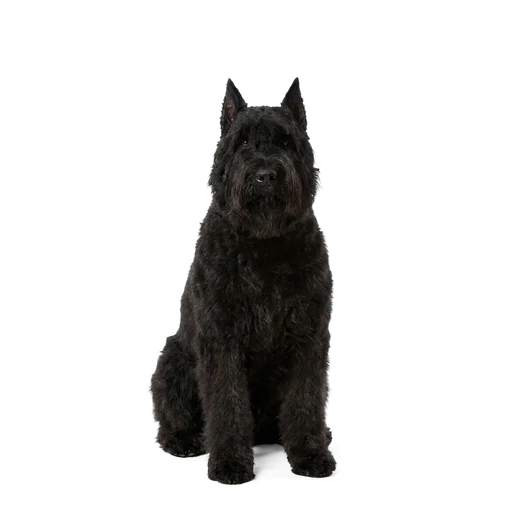
Origin: Belgium
Bouvier des Flandres
Get reminders for your Bouvier des Flandres's vaccines
Vaccination and parasite reminders, food-safety scans and health records — free to start in the Pethls app.


Good for
The Bouvier des Flandres is a big, rugged farm dog from the Flemish lowlands, built to herd cattle, pull carts, and guard the yard in foul weather. Under the tousled coat and impressive beard sits a calm, steady, deeply devoted dog that is fiercely loyal to its family and wary of strangers until they prove themselves. Adults run anywhere from 27 to 50 kg, and they know how to use that mass quietly. This is a superb companion for an experienced owner who will train consistently and provide real work; it is a poor match for a first-time owner hoping the dog will raise itself. Lifespan is typically 10 to 12 years.
Temperament & personality
Bouviers are thinking dogs. Bred to make independent decisions around livestock, they observe before they act, rarely waste energy, and carry a self-possessed calm indoors that surprises people expecting a boisterous giant. With their family they are affectionate in an undemonstrative way: a heavy head on your knee, a body parked across the doorway where they can watch everyone at once.
The guarding heritage is real. A Bouvier is naturally reserved with strangers and will place itself between its people and anything it finds suspicious. That instinct is an asset only when paired with heavy socialization from puppyhood and an owner who sets clear, consistent rules. An under-socialized, under-trained Bouvier of 45 kg is a genuine liability, which is why experienced homes matter for this breed.
With their own children they are typically patient and watchful, though a herding dog this size can flatten a toddler by accident and may try to shepherd running kids. Other pets are a mixed picture: many Bouviers live peacefully with cats and dogs they were raised with, but same-sex dog scuffles and chasing of strange animals are common enough that careful management is the default. Plan on an hour or more of daily exercise plus training, cart work, herding, or nosework to occupy the brain; a bored Bouvier redecorates.
Vaccination schedule
Bouvier puppies follow the standard core schedule: DHPP (distemper, hepatitis from adenovirus, parainfluenza, parvovirus) starting at 6 to 8 weeks, repeated every 3 to 4 weeks until at least 16 weeks of age. Large-breed puppies are just as vulnerable to parvovirus as small ones and arguably meet more of the world early, so finish the series before visiting high-traffic dog areas.
Rabies goes in once at 12 to 16 weeks depending on local law, with a booster at one year and then a one-year or three-year cycle per the licensed vaccine. Adult DHPP boosters typically move to every three years after the first annual booster, though your vet may titer-test instead where regulations allow.
A farm-bred working type that hikes, swims, or lives rurally is a strong candidate for leptospirosis vaccination, and dogs in training classes, daycare, or boarding should have bordetella. Because a Bouvier's vaccination record spans a decade across multiple products, keep the whole history in a health log; it also gives any emergency clinic instant answers when minutes matter.
Best food & diet
Growth is the critical nutritional window. A Bouvier puppy that will mature at 40-plus kg must grow slowly, because excess calories and calcium during growth worsen the odds of hip dysplasia. Feed a large-breed puppy formula, which controls calcium and energy density, until 15 to 18 months, and keep the puppy lean enough that you can feel ribs easily. Chubby puppies are not healthy puppies in this breed.
Adults typically need roughly 1,400 to 2,200 kcal per day depending on size, neuter status, and workload, fed as two measured meals. A quality large-breed adult food with named meat protein and added EPA and DHA supports joints; many owners add fish oil with veterinary guidance. Reassess portions seasonally, since a Bouvier that carts in autumn and naps in February does not need the same bowl year round.
Bloat, or gastric dilatation-volvulus, shapes feeding logistics for this deep-chested breed. Split the ration into at least two meals, avoid a single huge daily feed, discourage frantic gulping with a slow-feeder bowl, and keep hard exercise at least an hour before and an hour after meals. Discuss preventive gastropexy with your vet, often done during spay or neuter surgery; it does not stop the stomach from dilating but largely prevents the lethal twist.
Common health problems
Hip dysplasia is the breed's orthopedic headline. Malformed hip joints develop arthritis over years, showing as stiffness after rest, a rolling gait, or reluctance to jump into the car. Buy only from breeders with formal hip scores on both parents, keep the dog lean for life, and treat early with weight management, exercise modification, joint-support omega-3s, and vet-prescribed anti-inflammatories as needed. Surgical options exist for severe cases, from juvenile procedures to total hip replacement.
Two conditions deserve screening in any breeding line. Subaortic stenosis is a congenital narrowing below the aortic valve; mild cases just carry a murmur, while severe ones risk exercise intolerance and sudden death, so a cardiologist should evaluate any murmur found in a Bouvier puppy and breeding dogs should be screened by echocardiogram. Glaucoma also runs in the breed: a red, cloudy, painful, squinting eye is an emergency where hours determine whether vision survives, and dogs from affected lines benefit from routine eye pressure checks.
Laryngeal paralysis appears in older Bouviers, and the breed carries a hereditary early-onset form as well. The nerves controlling the airway opening fail, producing noisy, raspy breathing, a changed bark, and dangerous overheating in warm weather because panting stops working properly. Mild cases are managed with weight control, harnesses instead of collars, and heat avoidance; severe cases respond well to tie-back surgery, with aspiration pneumonia the main lifelong risk afterward.
Gastric dilatation-volvulus rounds out the list. The stomach fills with gas and rotates, cutting off its own blood supply, and an untreated dog can die within hours. Know the signs cold: unproductive retching, a swollen tight belly, drooling, pacing, and sudden distress, most often within a few hours of a meal. This is a drive-to-the-emergency-clinic-now condition, and prior gastropexy is the single best insurance against it.
Allergies & skin
Despite the enormous coat, Bouviers shed lightly; loose hair tends to stay caught in the undercoat rather than drifting onto floors. That does not make the breed hypoallergenic. Dander and saliva proteins are still produced in full-size-dog quantities, and the coat is a magnet for pollen carried in from outside, which can bother allergic household members as much as the dog itself.
The skin under all that hair needs airflow, and matting is its enemy. Tight mats trap moisture against the skin and brew hot spots (acute moist dermatitis), especially in warm weather or after swimming. If your Bouvier suddenly chews one spot raw under a mat, that is the mechanism. Thorough line brushing to the skin, complete drying after baths and swims, and prompt mat removal prevent most cases.
Individual dogs develop atopic dermatitis with the usual signs: paw licking, face rubbing on the carpet, recurrent ear infections under those hairy ear canals. Flea allergy is well hidden by the coat, so a flea comb check at the tail base is worth doing whenever an itch appears. For suspected food allergy, run a proper eight-to-twelve-week elimination diet with your vet and use an app to log itch scores, ear flare-ups, and diet dates; patterns across seasons are the diagnostic gold.
Flea, tick & worm prevention
A dense double coat is five-star tick real estate, and you will not spot a tick on a Bouvier by looking. Use year-round flea and tick prevention; many owners of heavily coated breeds prefer oral isoxazoline chewables because spot-ons must reach skin through a very thick coat to work reliably. After walks in fields or woods, comb through the beard, ears, armpits, and groin, which is where ticks concentrate.
Worming follows the standard protocol: puppies every two weeks from two to twelve weeks of age, then monthly until six months, then either continuous monthly broad-spectrum prevention or deworming guided by fecal exams every six to twelve months. Farm-adjacent Bouviers that scavenge, hunt rodents, or share ground with livestock need regular praziquantel for tapeworms. In heartworm regions, monthly prevention is mandatory for life.
Doses scale with weight, and this breed's 27 to 50 kg spread crosses product bands, sometimes into the largest size on the market. Weigh the dog every six months and after any body-condition change rather than reusing last year's box. Repeating reminders in a health log prevent the classic failure mode, which is not the wrong product but the forgotten month.
Medications & dosing
Everything a Bouvier takes is dosed by weight and should be directed by your vet, and at this size the arithmetic gets expensive and unforgiving in both directions. Underdosing a 48 kg dog with a preventive sized for 30 kg leaves it unprotected; overdosing anti-inflammatories risks stomach ulcers and kidney injury. Use an actual scale reading, not a guess, and recheck weight at least twice a year, since seniors often lose muscle mass that quietly changes their dose bracket.
Never reach for human painkillers. Ibuprofen and naproxen cause ulcers and kidney failure in dogs, and adding them to a vet-prescribed NSAID is a common and serious poisoning scenario. If your Bouvier is stiff or limping, call the clinic; dog-licensed NSAIDs such as carprofen or meloxicam are effective, affordable, and safe when dosed and monitored properly, usually with periodic blood work on long-term use.
Two breed-specific notes for the medicine cabinet. First, a Bouvier with laryngeal paralysis needs anesthesia and sedation plans tailored to a compromised airway, so make sure every clinic that treats the dog knows the diagnosis. Second, dogs with subaortic stenosis may need antibiotic and anesthesia considerations discussed with a cardiologist. Track every prescription, dose, and due date in a health log so multi-drug seniors stay on schedule across the whole household.
Grooming & coat care
The Bouvier's tousled double coat, a harsh dry outer layer over fine dense undercoat, was built for Flemish wind and rain, and it demands real upkeep. Plan on thorough brushing two to three times a week, thirty minutes or more per session, using a slicker and a coarse comb in layers down to the skin. Surface brushing is the classic mistake: the top looks tidy while felt forms underneath, and a severely matted Bouvier often has to be shaved to the skin to start over.
Trimming keeps the coat functional. Most pet Bouviers visit a groomer every six to eight weeks for a tidy of the body, feet, and hygiene areas, with the beard and eyebrows shaped rather than stripped away. The beard is a lifestyle item of its own: it dunks in every water bowl, collects every meal, and will drip on your trousers, so a quick daily wipe and comb-through prevents crusting and skin irritation beneath it.
Shedding is genuinely low for such a hairy dog, because dead hair lodges in the coat instead of falling, but that is exactly why the brushing schedule cannot slip. Finish the routine with nail trims every three to four weeks, weekly checks of the hair-lined ear canals with plucking or cleaning as your vet advises, and regular tooth brushing. Budget honestly: between tools, time, and professional grooming, coat care is one of the largest recurring costs of owning this breed.
How the Bouvier des Flandres compares
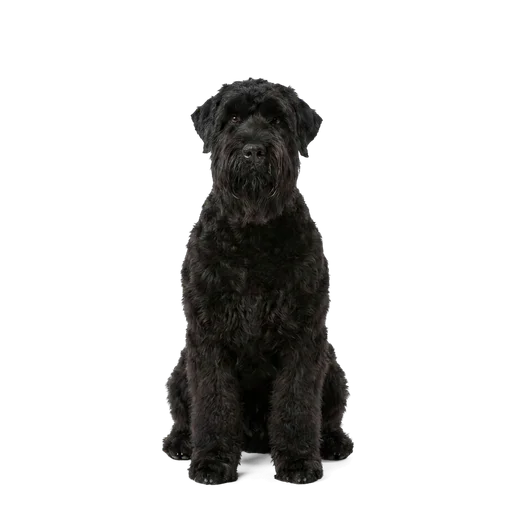
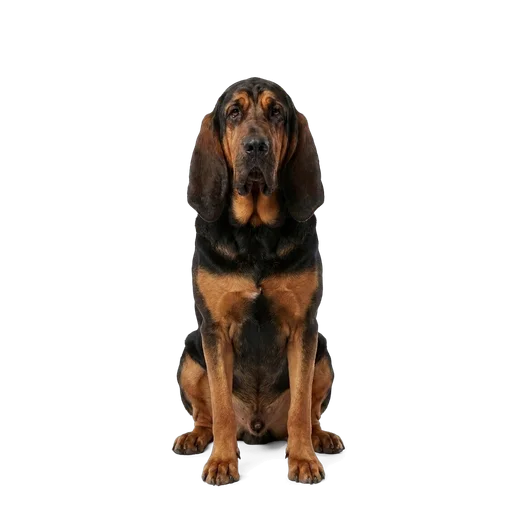
Deciding between similar breeds? Here is the Bouvier des Flandres next to Black Russian Terrier and Bloodhound.
| Bouvier des Flandres | Black Russian Terrier | Bloodhound | |
|---|---|---|---|
| Size | Large | Large | Large |
| Weight | 27-50 kg | 36-68 kg | 36-50 kg |
| Lifespan | 10-12 yrs | 10-12 yrs | 10-12 yrs |
| Activity | Moderate | Moderate | Moderate |
| Shedding | Low | Low | Medium |
| Good with kids | Yes | Yes | Yes |
| Apartment-friendly | No | No | No |
Frequently asked questions
Is a Bouvier des Flandres a good first dog?
Usually not. The size, guarding instinct, and independent working mind demand confident, consistent handling and serious early socialization. In experienced hands a Bouvier is calm, reliable, and wonderfully steady; in passive hands the same dog makes its own security decisions at 45 kg. First-time owners who insist should work closely with a trainer from day one.
Do Bouviers shed a lot?
No, shedding is light because dead hair stays trapped in the double coat rather than dropping. The catch is that the trapped hair mats if it is not brushed out several times a week, and the coat carries in leaves, burrs, mud, and pollen. Low shedding here means high grooming, not low maintenance.
What is bloat and why does it matter for this breed?
Bloat, or gastric dilatation-volvulus, is a life-threatening emergency where the stomach fills with gas and twists, and deep-chested breeds like the Bouvier are at elevated risk. Unproductive retching, a tight swollen belly, and sudden distress mean an immediate trip to an emergency vet. Feeding two or more meals daily, slowing fast eaters, and preventive gastropexy surgery all reduce the danger.
Are Bouviers good with children and other pets?
With their own children they are typically patient, protective, and gentle, though supervision matters because a herding dog this size can knock small kids over. Other pets are case by case: most do well with animals they grew up alongside, but some chase cats and many are selective about unfamiliar dogs, especially of the same sex.
How much exercise does a Bouvier des Flandres need?
About one to two hours a day, and quality counts as much as duration. Long walks, hiking, carting, herding lessons, obedience, or nosework satisfy the working brain far better than laps of the yard. Keep puppy exercise controlled on soft ground while joints develop, and go easy in hot weather, particularly for any dog with noisy breathing.
Related breeds
Health and care information is drawn from established veterinary sources and is general guidance, not veterinary advice. See our sources
Keep records for your Bouvier des Flandres
Vaccinations, food and treat safety, allergy alerts and parasite reminders - all tracked for your Bouvier des Flandres in the Pethls app.